 Watchlist Team
 13 Jul 2026
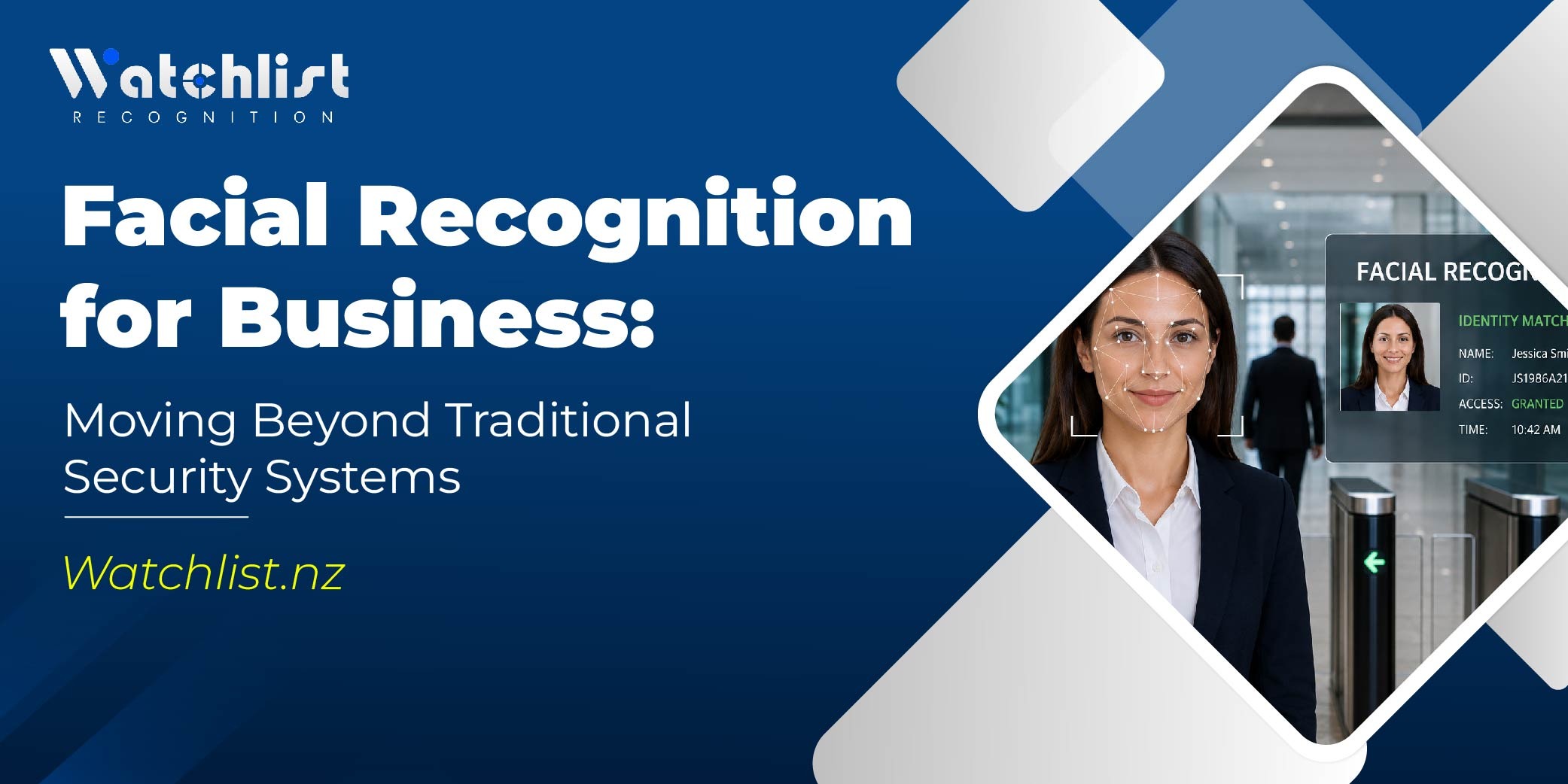
Facial Recognition for Business: Moving Beyond Traditional Security Systems
Traditional security systems were built around recording. Cameras captured footage; guards reviewed it when something went wrong; incidents were investigated after the fact. This model hasn't disappeared, but it's increasingly inadequate for organisations managing real operational risk across complex, multi-site environments.
Facial recognition for business represents a fundamental shift in what security infrastructure can do from passive documentation to active, real-time intelligence. But making that shift successfully requires more than buying the right technology. It requires deploying it the right way.
The Limits of Traditional Security
Consider what a traditional CCTV system actually provides. It records. When an incident occurs a theft, an assault, an unauthorised access event the footage becomes evidence. The response happens after the fact.
This is useful for investigations. It is not useful for prevention.
The gap between what happened and when you know about it is where organisations absorb the most cost: in staff safety incidents that could have been avoided, in losses that had already occurred before anyone was alerted, in repeat offenders who move through a site because there was no mechanism to recognise them.
A facial recognition platform closes this gap. When someone with a history of harmful behaviour enters a monitored premises, the system knows in real time. The right people are alerted. A response can occur before the next incident does.
What Real-Time Facial Recognition Enables
The operational use cases for facial recognition in business settings are broader than most organisations initially consider. Beyond security, they include:
Access control - replacing or augmenting card-based access systems with identity verification that cannot be shared, lost or stolen. Particularly valuable for high-security areas, data centres and facilities with strict authorisation requirements.
Repeat offender management - maintaining watchlists of individuals with a documented history of harmful behaviour and receiving alerts when they appear at any monitored site. This is the model adopted by major NZ and Australian retailers and it has demonstrably reduced serious incidents.
Contractor and visitor verification - confirming that the person presenting at a site entrance matches the identity on record for that visit, without requiring manual checking by reception staff.
Multi-site intelligence - in a distributed network of locations, knowing that the same individual has appeared at multiple sites within a short timeframe or has triggered alerts at a location hours away. This kind of pattern visibility is impossible with traditional CCTV.
Operational continuity - reducing the time staff spend manually reviewing footage, cross-referencing incident records, and managing access queries, freeing security and operations teams for higher-value work.
What Trusted Deployment Looks Like
Real-time facial recognition is powerful. That power needs to be matched by governance. In New Zealand, the Biometric Processing Privacy Code 2025 makes this a legal requirement but the most effective deployments treat trusted governance not just as a compliance obligation but as an operational discipline.
Trusted deployment means:
Human oversight in the loop. Automated matching surfaces alerts; trained people make decisions. The system does not act unilaterally. This protects against false positives and creates accountability at the point of action.
Watchlist governance. Criteria for adding individuals to a watchlist are clearly defined, documented, and reviewed. Exclusions for minors, for vulnerable individuals are enforced by the system, not just by policy.
Immediate deletion of non-matches. Individuals not on a watchlist are not retained. Their image is processed and discarded. This is both a privacy requirement and a practical discipline that keeps systems lean and defensible.
Audit trails. Every alert, every human review decision, every watchlist change is logged. When questions arise from regulators, from staff, from individuals the record is there.
Clear communication. Individuals in monitored spaces are informed through appropriate signage and publicly available documentation. Transparency reduces risk and builds legitimacy.
The Business Case
For organisations that have done the governance work, the return on investment in facial recognition for business is significant. Reduced theft and loss, lower security staffing requirements at entry points, faster incident response, reduced repeat offending and better cross-site visibility all contribute to the bottom line.
The organisations leading in this space - in retail, logistics, commercial property and critical infrastructure are those that treated the technology and the governance together as a single investment. They didn't deploy first and ask governance questions later. They built the foundation, then scaled it.
Watchlist.nz: Purpose-Built for the ANZ Business Environment
Watchlist.nz's facial recognition platform is designed specifically for the operational and regulatory context of Australia and New Zealand. It gives businesses the real-time recognition capability they need to move beyond reactive security alongside the governance controls, audit infrastructure and compliance alignment required to deploy with confidence.
Whether you're protecting a single site or building recognition capability across a national network, the platform is built to scale with you.